Building VeritasCode.tech: How I Created an AI Complaint Registration Agent
From Learning Artificial Intelligence to Building a Practical Solution for Organizations
By MM Hashmi | Founder of AI Success Academy
Introduction: Turning an AI Idea into a Practical Solution
Artificial intelligence is opening new opportunities for educators, entrepreneurs, small businesses, and professionals who want to solve real-world problems with technology.
A few years ago, building a digital solution for an organization might have required a development team, a substantial budget, and considerable technical expertise. Today, AI tools and modern automation technologies make it possible to explore new ideas, develop prototypes, and build practical solutions with fewer resources.
As the founder of AI Success Academy, I have a strong interest in helping people understand artificial intelligence and discover how it can be applied to everyday challenges.
My interest in practical AI applications led me to develop VeritasCode.tech, an AI agent designed to support complaint registration for different organizations.
The idea behind this project is straightforward: when people report a problem to an organization, the complaint should be recorded in an organized way so that it can be tracked and followed up.
I developed the agent and tested it myself. I am now working on marketing it to organizations that may benefit from a more organized complaint-registration process.
The product has not yet been sold to a customer, so I am treating this stage as an opportunity to introduce the solution, gather interest, and learn what potential users need.
In this article, I will share the idea behind VeritasCode.tech, the problem it aims to address, and some lessons from my journey of turning an AI concept into a practical product.
1. The Problem: Why Complaint Management Matters
Organizations receive complaints and service requests from many sources. Residents may report maintenance problems to a housing society, customers may raise issues with a business, and employees may submit requests to an administration department.
When these reports are handled through scattered phone calls, messages, paper registers, or informal conversations, several challenges can arise.
Complaints may be difficult to track
A person who submits a complaint may not know whether it has been recorded or forwarded to the responsible department.
Follow-ups can consume valuable time
Staff members may spend hours answering questions about the status of complaints instead of concentrating on the work needed to resolve them.
Information can become disorganized
When reports are stored in different places, it may be difficult to identify pending requests, review previous complaints, or understand recurring problems.
Accountability may be unclear
Without an organized record, managers may find it difficult to determine when a complaint was received, who is responsible for it, and what action has been taken.
These challenges will not occur in every organization, but they illustrate why a structured complaint-registration process can be valuable.
The objective of VeritasCode.tech is to help address this initial stage of the process by supporting the registration and organization of complaints.
2. The Idea Behind VeritasCode.tech
I wanted to develop a practical AI-based solution that could be relevant to different types of organizations rather than limiting the concept to one particular industry.
This led to the development of VeritasCode.tech, an AI complaint-registration agent.
The product is intended to help organizations make complaint intake more organized and provide a foundation for better tracking and follow-up.
Potential applications include:
- Housing societies and residential communities.
- Property management organizations.
- Customer service departments.
- Educational institutions.
- Offices and administrative departments.
- Businesses that receive maintenance requests or service complaints.
Each organization has different procedures, requirements, and communication channels. Therefore, the precise implementation would need to match the organization’s workflow.
The broader objective is to make complaint registration more systematic and easier to manage.
3. What Is an AI Complaint Registration Agent?
An AI complaint-registration agent is a digital assistant designed to help people submit complaints and help organizations organize the information they receive.
Depending on its implemented features and configuration, such an agent may support tasks such as:
Receiving complaint details: Helping a user provide information about a problem.
Organizing information: Structuring submitted details so they are easier to review.
Identifying complaint categories: Using AI to suggest whether a report concerns maintenance, security, cleaning, customer service, or another area, where this feature is supported.
Supporting the registration process: Helping ensure that submitted complaints enter the intended workflow.
Assisting with follow-up: Where appropriate integrations are available, connecting complaint records to notifications or status updates.
It is important to distinguish between the agent’s current, tested capabilities and features that may require additional integration or development. An AI agent does not automatically provide every function listed above simply because it uses artificial intelligence.
For organizations considering VeritasCode.tech, the relevant features should be demonstrated and verified before deployment.
4. How AI Can Improve Complaint Registration
Artificial intelligence can help make the process of handling incoming information more efficient.
For example, imagine that a housing society receives these reports:
- “The light in the parking area is not working.”
- “Water is leaking near the main entrance.”
- “The cleaning staff have not collected the rubbish.”
- “Someone has parked a vehicle in a restricted area.”
An AI-enabled workflow may be able to identify the main issue in each report and suggest an appropriate category.
This can help staff organize incoming complaints more consistently.
AI can also assist with summarizing longer descriptions, extracting relevant details, or identifying reports that may refer to the same problem, depending on the system’s capabilities.
However, AI-generated classifications are not always correct. A responsible system should allow staff to review uncertain cases, correct errors, and handle urgent complaints through an appropriate escalation process.
The purpose of AI is to support the people managing complaints, not to remove human responsibility for resolving them.
5. A Real Example: Testing the VeritasCode.tech Complaint Agent
The complaint registration process begins when a user scans a QR code displayed at prominent locations, such as reception areas, entrances, noticeboards, or other convenient places. Organizations can also distribute the QR code through printed notices, leaflets, cards, or other communication materials.
After scanning the QR code, the user can access the VeritasCode.tech AI complaint agent and register a complaint using the available text or audio interaction options.
During my testing, I submitted a sample complaint and received the following confirmation:
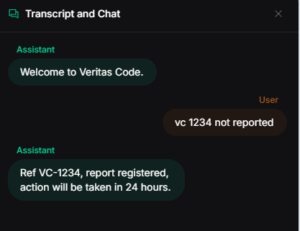
Ref VC-1234, report registered, action will be taken in 24 hours.
This example demonstrates how the agent provides a reference number to help identify a registered complaint. After registration, the process can provide feedback to the user, while any subsequent status updates depend on the organization’s configured workflow.
The process follows a simple sequence:
Scan QR Code → Register Complaint → Receive Reference Number → Get Feedback
My testing demonstrates this sample registration interaction. The product is now being introduced to potential organizations, where further testing can help evaluate its performance in real-world conditions.
6. From Concept to Development and Testing
Creating VeritasCode.tech has been part of my practical journey into AI development and application.
My work has involved moving beyond the general discussion of AI and focusing on a specific organizational problem: how complaint registration can be made more structured.
The development process has also reinforced an important lesson. An idea becomes a useful product only when it is translated into a process that people can understand, test, and use.
After developing the agent, I tested it myself to examine its operation and evaluate the concept.
This personal testing is an important initial step, but it is not the same as a full deployment within an organization. Real-world use can reveal requirements that are difficult to anticipate during individual testing, including differences in staff procedures, user expectations, data handling, and integration needs.
The next stage is to introduce the product to potential customers, demonstrate its capabilities, understand their requirements, and identify opportunities for improvement.
I believe this is a natural part of building a practical technology product.
7. Why Organizations Might Consider an AI Complaint Agent
An organization should consider a new technology only when it addresses a genuine need.
A complaint-registration agent may be worth evaluating when an organization wants to improve how it receives and organizes complaints.
Potential benefits, depending on the implementation, include:
- More organized intake: Complaint details can be collected in a consistent format.
- Improved visibility: Structured records can make it easier to review incoming and pending complaints.
- Less repetitive administration: Suitable automated tasks may reduce some manual work.
- Better information for managers: Organized complaint data can help identify recurring issues.
- A foundation for further automation: Registration can potentially be connected to assignment, notifications, tracking, and feedback processes.
These are potential benefits, not guaranteed outcomes. Their value must be evaluated in the context of an organization’s existing processes and the product’s verified capabilities.
A successful solution should also be easy for users to understand and should fit the organization’s operational requirements.
8. Why I Am Now Focusing on Marketing
Developing a product is only one part of the entrepreneurial journey. The next challenge is finding organizations that have the problem the product is intended to address.
I am currently working on marketing VeritasCode.tech and introducing the concept to potential users.
At this stage, the product has been developed and tested by me, but it has not yet been sold to a customer.
I consider this an important stage in the product’s journey. Marketing can help me discover which organizations are interested, what features they value, what concerns they have, and what changes may be necessary before wider adoption.
Rather than claiming success before it has been demonstrated, I want to approach this process with realistic expectations and a willingness to learn.
The first organizational deployment, when it takes place, can provide valuable feedback about how the agent performs in a real working environment.
That feedback can guide future improvements and help establish whether the product meets customer needs.
9. Important Considerations Before an Organization Adopts AI
Organizations considering an AI complaint-registration solution should examine more than its ability to respond to a user.
They should also consider several practical questions.
Data protection
Complaints may contain names, contact details, addresses, photographs, or other personal information. Access should be restricted to authorized people, and information should be collected and retained responsibly.
Accuracy
AI may misunderstand a complaint or assign an incorrect category. Staff should have a way to correct errors and review uncertain cases.
Accountability
The organization must determine who is responsible for reviewing complaints, assigning work, and confirming resolution.
Reliability
The workflow should have a plan for technical failures, missing information, and unsuccessful notifications.
Integration
The organization should understand whether the product works with its preferred communication channels, existing software, and internal procedures.
Human oversight
Urgent safety issues and other high-priority complaints need a clear escalation process. They should not depend entirely on an automated agent.
Addressing these considerations is essential when moving from a personally tested product to organizational use.
10. Lessons from My AI Product Development Journey
Developing VeritasCode.tech has strengthened my belief that learning AI is not only about understanding concepts or experimenting with tools. It is also about identifying problems and exploring practical solutions.
Here are five lessons I would share with other beginners and aspiring entrepreneurs.
Lesson 1: Start with a real problem.
A useful product begins with a clear understanding of the difficulty it is meant to address.
Lesson 2: Focus on a specific purpose.
A product designed to support complaint registration has a clearer initial objective than a general tool that tries to do everything.
Lesson 3: Test before making claims.
Personal testing helps evaluate a product’s basic operation, but customer use is needed to understand how well it performs in different environments.
Lesson 4: Marketing is part of product development.
Conversations with potential customers can reveal important requirements and help determine whether the product addresses a real market need.
Lesson 5: Keep learning and improving.
AI technology continues to develop. A responsible creator should evaluate feedback, correct weaknesses, and improve the product over time.
These lessons are relevant not only to AI agents but also to websites, digital services, educational products, and other technology-based ventures.
11. The Road Ahead for VeritasCode.tech
My immediate objective is to introduce VeritasCode.tech to organizations that may benefit from an AI-supported complaint-registration process.
The next stage is to connect with interested organizations, demonstrate the product, understand their requirements, and explore opportunities for a pilot implementation.
A pilot can help determine whether the solution fits the organization’s workflow, which features are most useful, and what improvements are needed.
I also recognize that product development is an ongoing process. Customer feedback, operational requirements, and practical experience will all be important in shaping the product’s future.
I hope that VeritasCode.tech will become a useful option for organizations looking to improve their complaint-registration processes. Its commercial potential will ultimately depend on customer needs, product performance, and the value it delivers in practice.
Conclusion: From Learning AI to Building Practical Solutions
Artificial intelligence offers opportunities for people who are willing to learn, experiment, and work on real problems.
My experience developing VeritasCode.tech has been one step in that direction. I identified a practical use case, created an AI complaint-registration agent, tested it myself, and began working on marketing it to potential customers.
The product has not yet achieved its first sale, and there is more to learn. Nevertheless, I believe that building, testing, listening to feedback, and improving are valuable parts of the entrepreneurial process.
Through AI Success Academy, I want to encourage learners to look beyond simply using AI tools and explore how these technologies can support meaningful projects.
You do not have to begin with a large company or an expensive development team. You can start by identifying one problem, learning the relevant tools, building a focused solution, and testing it carefully.
The journey from learning AI to creating a practical AI product begins with an idea, but it progresses through testing, feedback, and continuous improvement.
About the Author
MM Hashmi is the founder of AI Success Academy, an online learning platform focused on artificial intelligence, digital skills, AI tools, and practical learning resources. He is also an educator and Amazon KDP author who is interested in making emerging technologies accessible to beginners.
He developed VeritasCode.tech, an AI agent designed to support complaint registration for organizations, as part of his practical exploration of AI applications.
Visit AI Success Academy to explore educational articles, courses, ebooks, and AI learning resources.
Explore VeritasCode.tech
Organizations interested in AI-supported complaint registration can visit VeritasCode.tech to learn more about the project and explore whether it may suit their requirements.
Product capabilities, integration requirements, and suitability should be confirmed directly before any organizational deployment.