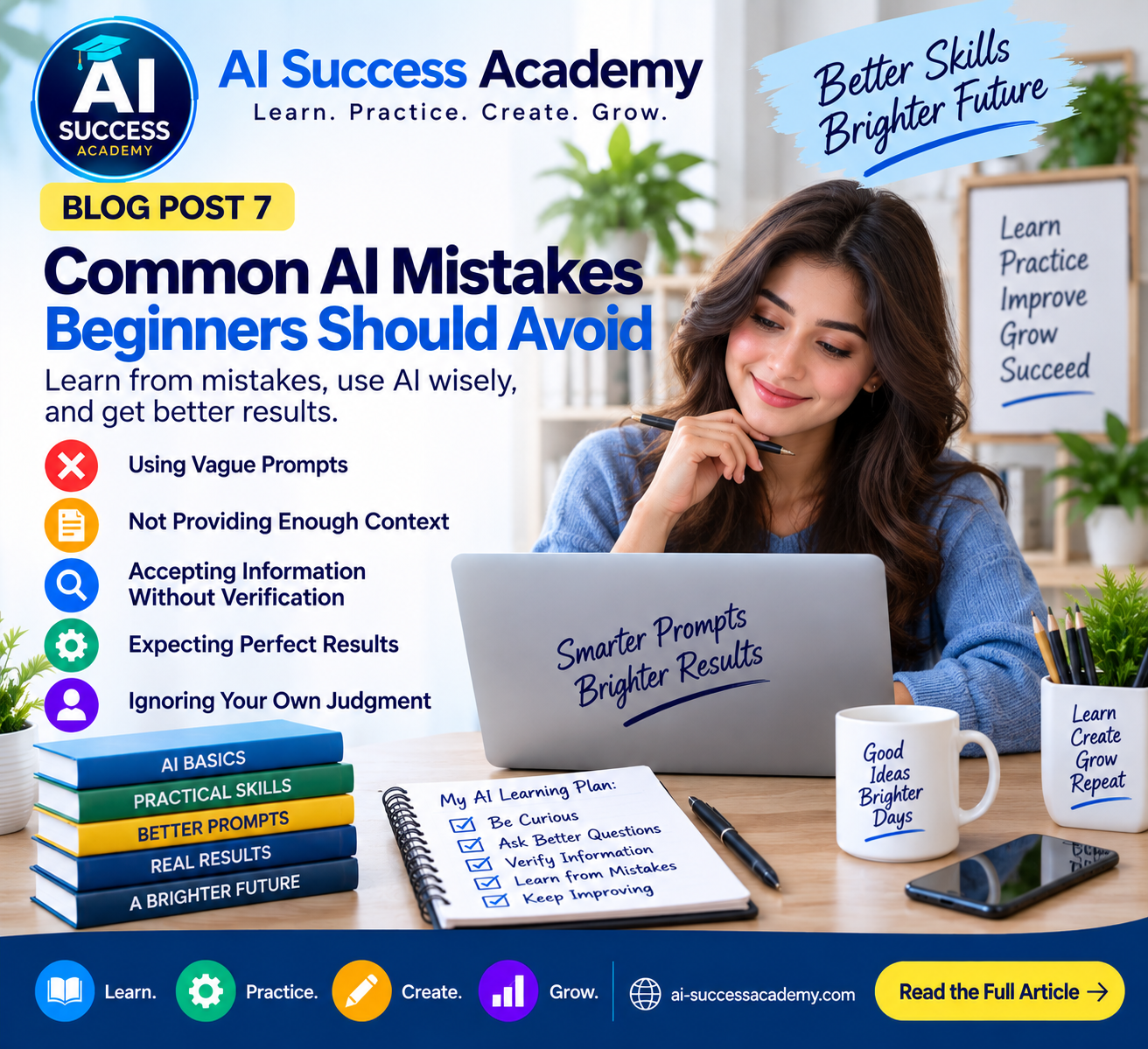
Common AI Mistakes Beginners Should Avoid
Artificial Intelligence has become one of the most powerful tools available today. Millions of people use AI tools such as ChatGPT to learn new skills, create content, conduct research, solve problems, and improve productivity. However, many beginners make simple mistakes that prevent them from getting the best results.
The good news is that most of these mistakes are easy to avoid. By understanding how AI works and learning a few best practices, you can dramatically improve the quality of your results.
In this guide, we’ll explore the most common AI mistakes beginners make and how to avoid them.
1. Asking Vague Questions
One of the biggest mistakes beginners make is providing very little information.
For example:
Tell me about marketing.
This question is too broad. AI does not know whether you want to learn digital marketing, social media marketing, email marketing, or something else.
A better prompt would be:
Explain digital marketing for beginners and provide five practical strategies for small businesses.
The more specific your question, the better the response.
2. Not Providing Enough Context
AI performs best when it understands your goal, audience, and situation.
For example:
Write a blog post about AI.
This provides little context.
A better prompt would be:
Write a 700-word beginner-friendly blog post about AI for students interested in learning digital skills.
Providing context helps AI generate more relevant and useful responses.
3. Expecting Perfect Results Immediately
Many beginners believe AI should provide the perfect answer on the first attempt.
In reality, AI works best through conversation and refinement.
If the first response isn’t exactly what you need, try:
- Asking follow-up questions
- Requesting additional details
- Changing the format
- Providing more context
The best results often come after a few improvements and adjustments.
4. Trusting AI Without Verification
AI is powerful, but it can sometimes provide outdated, incomplete, or incorrect information.
Always verify:
- Facts
- Statistics
- Dates
- Sources
- Technical information
This is especially important for research, education, business, legal, financial, and health-related topics.
Think of AI as a helpful assistant, not an infallible expert.
5. Ignoring Human Judgment
AI can generate ideas and suggestions, but human judgment remains essential.
Successful users combine:
- Human creativity
- Critical thinking
- Personal experience
- AI assistance
The final decisions should always be made by people.
6. Using AI for Everything
Some beginners try to use AI for every task.
While AI is extremely useful, not every problem requires artificial intelligence.
Sometimes traditional methods, personal experience, research, or direct communication are better solutions.
Use AI where it adds value rather than forcing it into every situation.
7. Copying AI Content Without Editing
Another common mistake is copying AI-generated content directly into blogs, assignments, websites, or social media posts.
Always review and improve the content by:
- Checking accuracy
- Correcting grammar
- Adding personal insights
- Including examples
- Improving readability
Your expertise and unique perspective make content more valuable.
8. Forgetting to Define the Desired Format
AI can provide information in many formats:
- Lists
- Tables
- Articles
- Summaries
- Step-by-step guides
- Social media posts
If you don’t specify the format, the response may not match your needs.
For example:
Create a step-by-step guide for starting an online business.
This instruction is clearer than simply asking about online business.
9. Not Learning Prompting Skills
Prompting is the skill of communicating effectively with AI.
The quality of your prompt often determines the quality of the response.
Good prompts include:
- Clear objectives
- Specific instructions
- Relevant context
- Desired format
- Target audience
Learning prompt-writing skills is one of the fastest ways to improve AI results.
10. Thinking AI Replaces Learning
AI can accelerate learning, but it should not replace learning.
Use AI to:
- Understand concepts
- Generate explanations
- Practice skills
- Explore ideas
The goal is to learn and grow, not simply receive answers.
People who use AI as a learning partner often gain the greatest long-term benefits.
Best Practices for Success
To get the most from AI:
 Be specific
Provide context
Verify important information
Review and edit outputs
Use follow-up questions
Continue learning prompting skills
Combine AI with human judgment
These habits will help you achieve more accurate, reliable, and valuable results.
Conclusion
Artificial Intelligence is transforming how people learn, work, and create. However, beginners often make simple mistakes that limit its effectiveness. By asking better questions, providing useful context, verifying information, and applying human judgment, you can unlock the true potential of AI.
Remember that AI is a powerful tool, but the most important part of the process is still you. The combination of human intelligence and artificial intelligence creates the best results.
As you continue your AI journey, focus on learning, practicing, and improving your prompting skills. Over time, you’ll become more confident, productive, and successful in using AI tools.
AI Success Academy
Learn. Practice. Create. Grow. 
