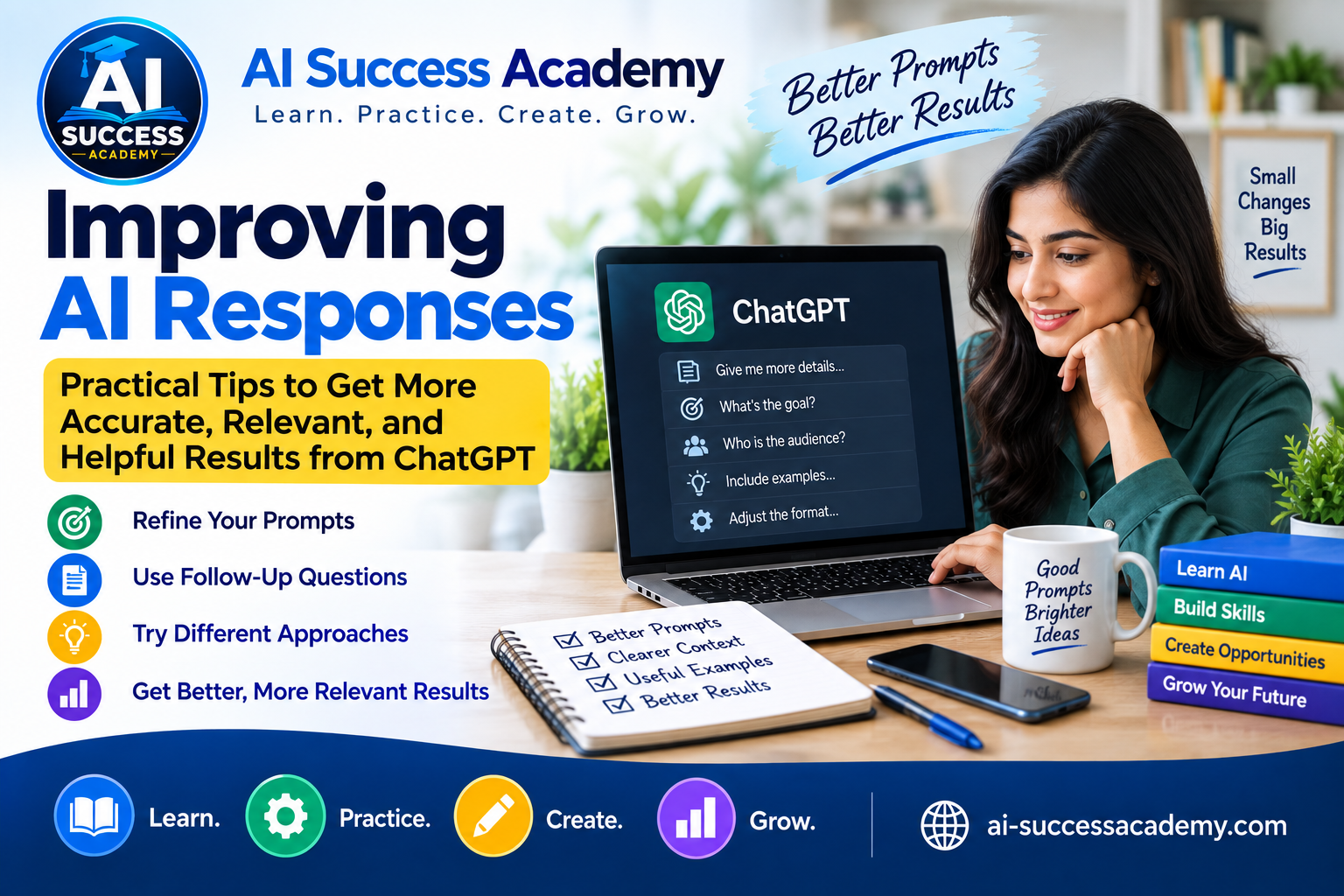
How to Improve AI Responses
Artificial Intelligence tools like ChatGPT can save time, generate ideas, assist with writing, and help solve problems. However, many users assume that the first response they receive is the best response possible. In reality, one of the most important AI skills is learning how to improve and refine AI responses.
The quality of the answers you receive depends not only on the question you ask but also on how you interact with the AI after it responds. By using a few simple techniques, you can transform an average answer into a highly useful and personalized result.
Why AI Responses Are Not Always Perfect
AI generates responses based on patterns in data and the information you provide. Sometimes the response may be:
- Too general
- Too short
- Missing important details
- Not in the desired format
- Written for the wrong audience
This does not mean the AI failed. It simply means you need to guide it further.
Think of AI as a helpful assistant. The more direction you provide, the better the outcome.
Technique 1: Ask for More Details
If a response is too brief, ask the AI to expand on specific points.
Instead of accepting a short answer, try:
- Explain this in more detail.
- Provide examples.
- Give step-by-step instructions.
- Expand section three.
For example:
Initial Prompt:
How can I start freelancing?
Follow-Up Prompt:
Explain the first three steps in detail and provide practical examples.
The second response will usually be much more valuable.
Technique 2: Request a Different Format
Sometimes the information is correct, but the presentation is not what you need.
You can ask AI to rewrite the information as:
- Bullet points
- Numbered lists
- Tables
- Checklists
- Blog posts
- Social media posts
- Professional emails
For example:
Convert this explanation into a simple checklist for beginners.
This often makes information easier to understand and use.
Technique 3: Define the Audience
The same topic can be explained in different ways depending on who is reading it.
Try adding:
- For beginners
- For students
- For business owners
- For freelancers
- For children
Example:
Explain machine learning to a complete beginner using simple language.
This helps AI adjust the complexity and style of its response.
Technique 4: Ask for Examples
Examples often make difficult concepts easier to understand.
For instance:
Give three real-world examples.
or
Show me a practical example of this strategy.
Examples help bridge the gap between theory and application.
Technique 5: Use Follow-Up Questions
Many users make the mistake of starting a completely new conversation instead of building on an existing one.
AI can improve responses when you continue the discussion.
Examples:
- Can you explain that differently?
- What are the advantages and disadvantages?
- Can you simplify this?
- Can you make it more professional?
- Can you provide another example?
Each follow-up helps refine the answer.
Technique 6: Ask AI to Critique Its Own Response
One powerful technique is asking AI to review its work.
Try prompts such as:
Improve this answer.
What important points are missing?
Rewrite this to make it more engaging.
How can this response be better?
AI can often identify weaknesses and improve its own output.
Common Mistakes to Avoid
When trying to improve AI responses, avoid:
- Using very short prompts
- Providing little context
- Expecting perfection on the first attempt
- Ignoring follow-up questions
- Accepting vague answers without clarification
The best results usually come from a short conversation rather than a single prompt.
Final Thoughts
Getting better results from AI is not about finding a secret prompt. It is about learning how to guide the conversation. By asking for more detail, changing formats, defining your audience, requesting examples, and using follow-up questions, you can significantly improve the quality of AI-generated content.
The most successful AI users understand that AI works best as a collaborative tool. The more clearly you communicate your needs, the more accurate, useful, and valuable the responses become.
Mastering these simple techniques will help you use AI more effectively for learning, business, content creation, research, and everyday productivity.
Learn. Practice. Create. Grow.
AI Success Academy
Also Read Blog Post: