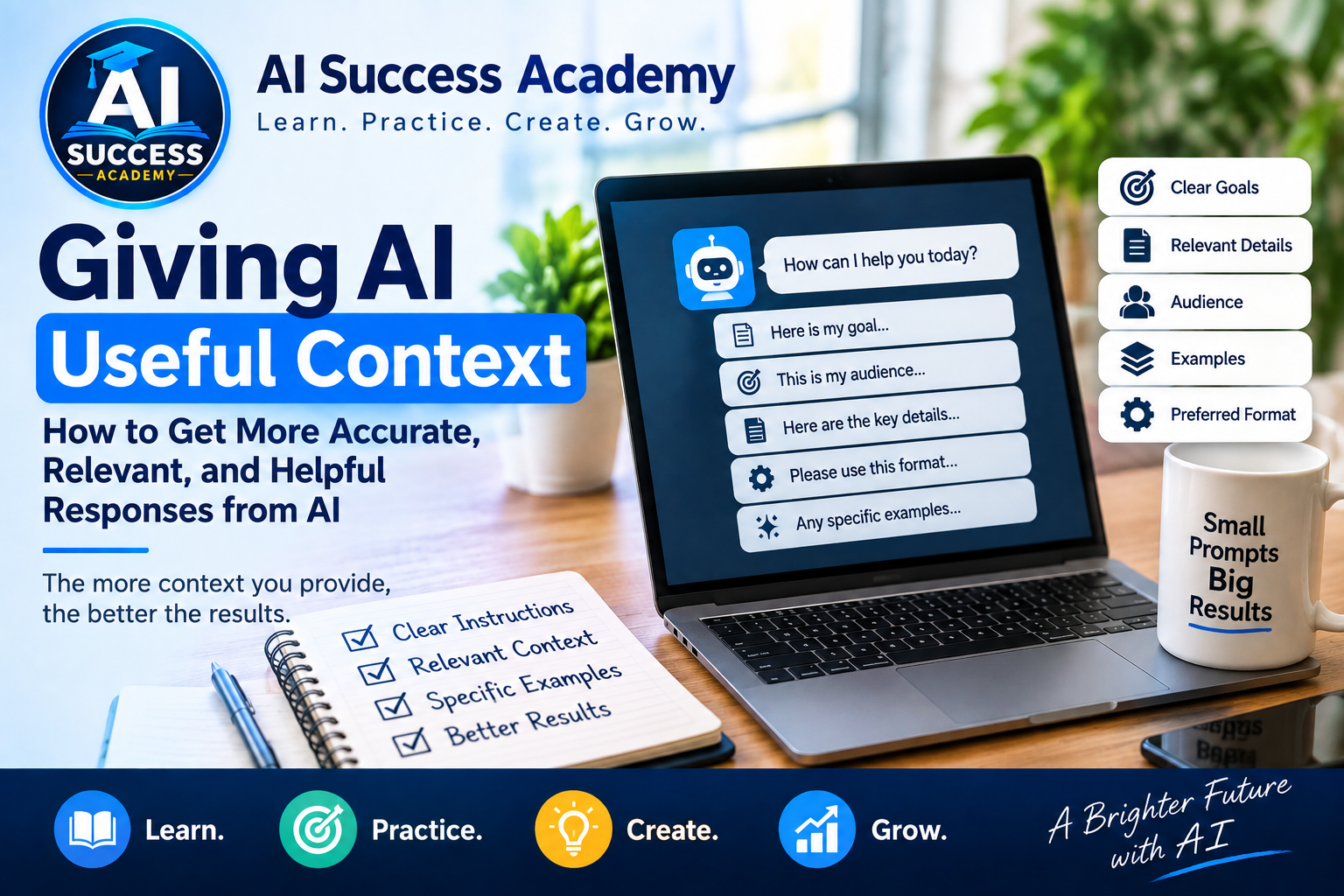
The Key to Better AI Responses
Artificial Intelligence tools such as ChatGPT can help with writing, research, learning, business planning, coding, and many everyday tasks. However, many users are disappointed when they receive vague, inaccurate, or incomplete answers. In most cases, the problem is not the AI itself—it is the lack of context provided in the prompt.
Giving AI useful context is one of the most important skills for getting high-quality results. The more relevant information you provide, the better the AI can understand your request and generate a response that meets your needs.
What Is Context?
Context is the background information that helps AI understand what you want. It explains the purpose of your request, your audience, your goals, and any important details that can guide the response.
For example, instead of asking:
“Write an article about AI.”
You can provide context by saying:
“Write a beginner-friendly 700-word blog post about artificial intelligence for students who are learning AI for the first time.”
The second prompt gives the AI much more information about the topic, audience, and expected result.
Why Context Matters
AI does not know who you are, what your goals are, or what project you are working on unless you tell it. When you provide useful context, AI can:
Produce more accurate responses
Better understand your objectives
Save time by reducing revisions
Create content suited to your audience
Generate more relevant and practical ideas
Think of AI as a skilled assistant. The clearer your instructions, the better the outcome.
Important Types of Context to Provide
1. Your Goal
Explain what you want to achieve.
Examples:
Create a blog post
Write a lesson plan
Generate marketing content
Research a topic
Prepare a business proposal
When AI understands your goal, it can tailor the response accordingly.
2. Your Audience
Tell AI who will read or use the content.
Examples:
Beginners
Students
Teachers
Small business owners
Freelancers
Professionals
A response written for beginners will be very different from one written for experts.
3. Relevant Details
Provide any information that may affect the answer.
Examples:
Topic focus
Word count
Industry
Location
Style preferences
Existing content
The more relevant details you provide, the more personalized the response becomes.
4. Examples
Examples help AI understand exactly what you are looking for.
For example:
“Write in a simple style similar to a beginner’s guide.”
or
“Use short paragraphs and practical examples.”
Examples reduce confusion and improve consistency.
5. Preferred Format
Tell AI how you want the information presented.
Examples:
Blog post
List
Table
Lesson
Email
Social media post
Step-by-step guide
Format instructions help AI organize information effectively.
Comparing Two Prompts
Weak Prompt
“Tell me about online business.”
Strong Prompt
“Write a 700-word beginner-friendly article explaining online business opportunities for people who want to start an online income stream in 2026.”
The second prompt gives context about length, audience, purpose, and time frame. As a result, the response will usually be much more useful.
Using Context in Everyday Tasks
Providing context can improve results in many situations:
Content Creation
Tell AI:
Your target audience
Content length
Writing style
Topic focus
Learning
Tell AI:
Your current knowledge level
What you want to learn
Any specific questions
Business Planning
Tell AI:
Your industry
Business goals
Target customers
Budget or limitations
Problem Solving
Tell AI:
The problem
What you have already tried
Desired outcome
This helps AI provide more practical suggestions.
Common Mistakes to Avoid
Many users make these mistakes:
Using very short prompts
Leaving out important details
Not specifying the audience
Forgetting to mention goals
Expecting AI to guess their intentions
Remember that AI works best when it receives clear instructions and useful context.
Final Thoughts
Giving AI useful context is one of the simplest ways to improve your results. Whether you are writing content, learning new skills, planning a business, or solving problems, context helps AI understand exactly what you need.
Instead of asking AI to guess, provide clear goals, relevant details, examples, audience information, and formatting preferences. Small improvements in your prompts can lead to dramatically better responses.
The more context you provide, the more accurate, relevant, and helpful the AI becomes.
To learn how to write clearer prompts and get more accurate AI responses, read our article:Asking Better Questions for Better ChatGPT Result
AI Success Academy Tip:
Before sending a prompt, ask yourself: “Have I provided enough information for AI to understand exactly what I want?” If the answer is yes, you are much more likely to receive high-quality results.
Meta Description:
Learn how giving AI useful context improves ChatGPT responses. Discover practical techniques to get more accurate, relevant, and helpful AI-generated results.
Pingback: How to Improve AI Responses: Simple Techniques for Better Results - AI Success Academy